Dream Analysis · Jungian Psychology
Why You Keep Having the Same Dream (And What It Means)
You know the one. The dream that keeps coming back.
Maybe you are running from something you cannot see. Maybe you are sitting an exam you never studied for, in a subject you finished years ago. Maybe your teeth are crumbling in your mouth, or you are wandering through a house that feels familiar but has rooms you have never entered before. Maybe it is a person — someone who keeps appearing, night after night, saying something you can never quite remember when you wake.
You brush it off the first time. The second time, you notice. By the tenth time, you cannot ignore it anymore. Something in you is repeating this dream on purpose.
And it is.
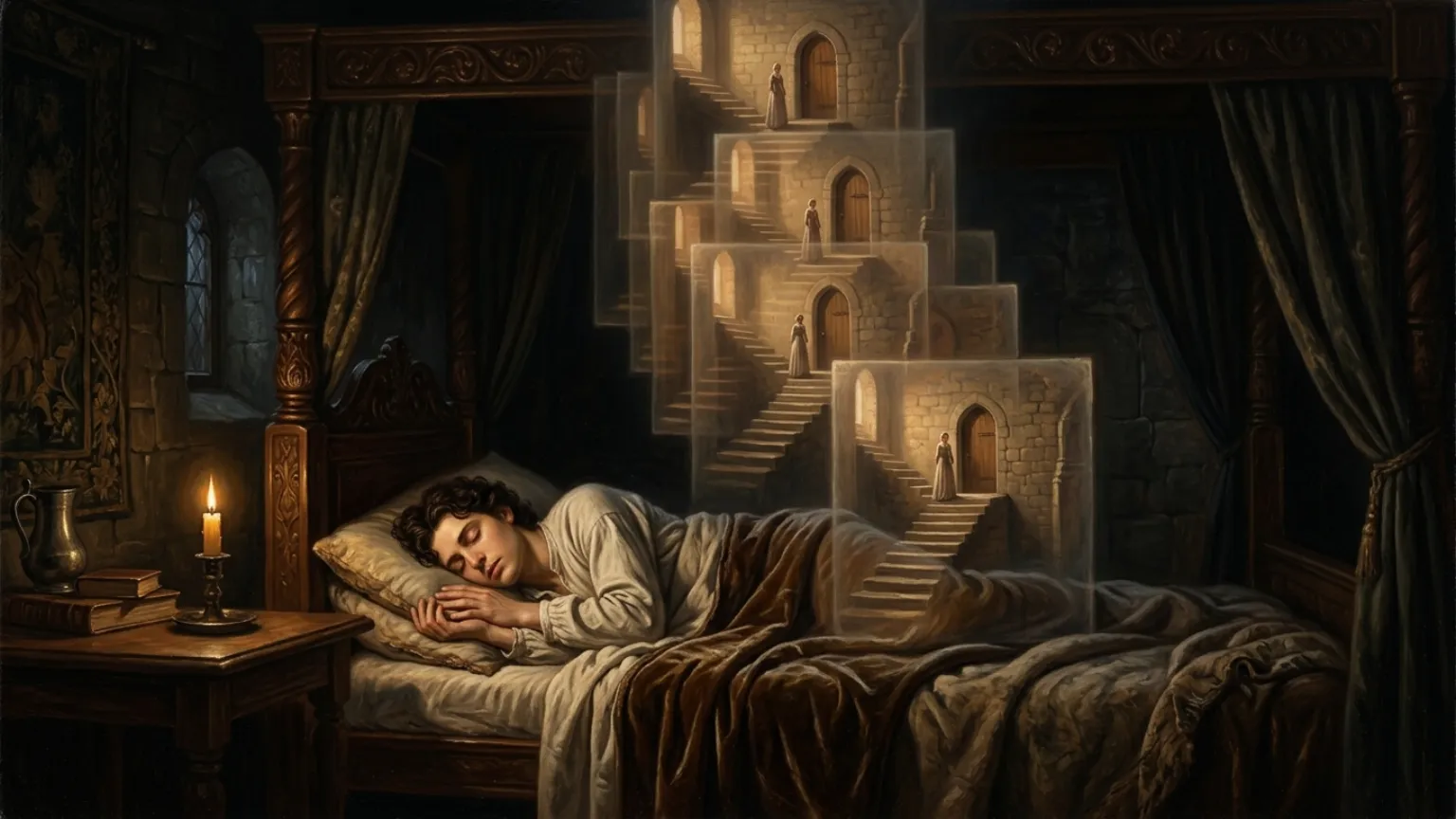
Recurring dreams are not glitches. They are not your brain replaying random footage while it files away memories from the day. According to Carl Jung, one of the most influential psychologists of the twentieth century, a recurring dream is your unconscious mind sending you the same message — over and over — because you have not heard it yet.
Reflective note: dream reflection on Soulink is symbolic self-reflection, not diagnosis, prediction, therapy, or medical advice.
"The general function of dreams is to try to restore our psychological balance by producing dream material that re-establishes, in a subtle way, the total psychic equilibrium."
— Carl Jung, Man and His SymbolsThis is what your recurring dream is trying to do: restore a balance that your waking life has lost. And it will keep trying until you finally listen.
What Science Says About Recurring Dreams
Before we go deeper into the psychological meaning, it is worth knowing what modern research has confirmed.
Studies show that nearly two-thirds of people experience recurring dreams. They are one of the most universal human experiences — as common across cultures today as they were in ancient civilizations that took dreams seriously as messages from the gods.
Research from the Université de Montréal found that recurring dreams are strongly associated with unresolved psychological conflict. They tend to appear during periods of stress, persist as long as the conflict remains unaddressed, and disappear once the person has worked through the underlying issue. The emotional content is overwhelmingly negative — fear, guilt, anger, helplessness — and more than half of recurring dreams involve scenarios where the dreamer is in some form of danger.
Here is the key finding: recurring dreams are not random repetitions. They are metaphorical representations of an emotional problem that your waking mind has not resolved. The dream keeps returning because the problem keeps returning. The moment you genuinely address what the dream is pointing to, it stops.
That pattern — repetition until resolution — is exactly what Jung described over a century ago.
Jung's View: A Letter You Keep Refusing to Open
Jung described dreams as messages from the unconscious. If a regular dream is a letter, a recurring dream is the same letter being sent again and again — because you keep throwing it away without reading it.
"Dreams are, after all, compensations for the conscious attitude."
— Carl JungIn Jungian psychology, every dream serves a compensatory function. It corrects for something that is off-balance in your conscious life. If you are being too rigid, the dream sends flexibility. If you are avoiding something painful, the dream puts it directly in front of you. If you have suppressed a part of yourself — your shadow, your creativity, your grief — the dream forces a confrontation. Our guide to Jungian dream analysis walks through how this compensation model works in everyday dreams.
A recurring dream, then, is a compensation that has failed to be received. The unconscious is patient, but it is also persistent. It will keep sending the same message, in the same symbolic language, until the conscious mind finally acknowledges what it has been trying to ignore.
Jung was explicit about this:
"The dream compensates for the deficiencies of their personalities, and at the same time it warns them of the dangers in their present course. If the warnings of the dream are disregarded, real accidents take their place."
— Carl Jung, Man and His SymbolsThat warning is not supernatural. It is psychological. A recurring dream is telling you: something in your life is unresolved, and if you do not deal with it consciously, it will deal with you unconsciously — through anxiety, relationship breakdowns, self-sabotage, or worse.

The Most Common Recurring Dreams (And What They Point To)
While every dream is personal, certain recurring themes appear so frequently across the human population that they are considered universal. Here is what the most common ones typically point to, from a depth psychology perspective.
Being Chased
The most reported recurring dream worldwide. You are running from something — a figure, an animal, a nameless threat — and no matter how fast you move, it keeps gaining on you.
In Jungian terms, the pursuer is almost always your Shadow: the rejected, denied, or unconscious part of your own personality. You have been avoiding something about yourself, and the harder you run from it, the closer it gets. The dream will not stop until you turn around and face what is behind you. If this resonates, our shadow work guide covers how to begin integrating what is being avoided.
Teeth Falling Out
Teeth represent your grip — on reality, on self-image, on control. Losing them in a dream often signals a fear of losing power, attractiveness, or competence. It frequently appears during life transitions: a new job, the end of a relationship, aging.
Research has also found a physiological component — teeth-clenching during sleep can trigger these dreams. But the emotional meaning remains: something feels like it is crumbling, and you feel powerless to stop it.
Falling
The sudden drop. The stomach-lurching freefall. Falling dreams are connected to feelings of losing control — of a situation, of your life direction, of your sense of stability. They tend to intensify during periods of uncertainty or when you feel the ground beneath a major life structure is giving way.
Being Unprepared for an Exam
You are back in school. You forgot to study. You cannot find the classroom. The test is starting and you have no idea what it is about.
This dream has nothing to do with school. It is about performance anxiety — the feeling that you are about to be evaluated and found lacking. It returns whenever you face a situation where you feel inadequate, underprepared, or exposed. The "exam" is a metaphor for any moment of judgment.
Being Late or Unable to Get Somewhere
You need to be somewhere and everything is going wrong. The road keeps shifting. Your legs feel heavy. You miss the train. You cannot find the door.
This recurring dream often reflects a deeper sense that time is passing and you are not where you want to be in life. It can point to goals you have abandoned, a life you feel is slipping away from you, or the frustration of feeling stuck while everything around you moves forward.
Being Naked in Public
Exposure. Vulnerability. The fear of being seen without your social mask — your persona, in Jungian language. This dream recurs when there is a growing gap between who you present to the world and who you actually are underneath.
A House with Unknown Rooms
You are in a familiar house, but you discover rooms you never knew existed. This is one of the most symbolically rich recurring dreams in Jungian interpretation. The house represents your psyche. The unknown rooms represent parts of yourself you have not yet explored — untapped potential, suppressed memories, undeveloped aspects of your personality.
If this dream keeps returning, it is an invitation: there is more to you than you currently know.

Why Your Recurring Dream Keeps Coming Back
If recurring dreams resolve when the underlying issue is addressed, why do they persist for so long in some people — years, sometimes decades?
Because the issue itself persists. And often, the dreamer does not realize what the issue actually is.
A recurring dream speaks in metaphor. It does not say "you are afraid of abandonment." It puts you on a train platform watching someone leave. It does not say "you have suppressed your anger for twenty years." It puts a dark figure in your hallway that grows larger every time you try to close the door.
The symbolic language of dreams is why most people cannot decode recurring dreams on their own. They feel the emotion — the fear, the frustration, the grief — but they do not connect it to the real-life source. So the dream keeps repeating, waiting for the connection to be made.
Jung's approach to this problem was simple in principle but difficult in practice: stop interpreting the dream literally, and start asking what emotional truth it represents.
"Dreams prepare, announce, or warn about certain situations, often long before they actually happen. This is not necessarily a miracle or a precognition. Most crises or dangerous situations have a long incubation, only the conscious mind is not aware of it. Dreams can betray the secret."
— Carl Jung, The Symbolic LifeYour recurring dream is not predicting the future. It is revealing the present — the emotional present that your conscious mind has been too busy, too scared, or too defended to acknowledge.
How to Work with a Recurring Dream
You do not need to be a psychologist to begin understanding your recurring dream. But you do need to approach it with patience and honesty. Here is a practical process rooted in Jung's method.
Write It Down in Full Detail
The next time the dream occurs, write down everything — immediately, before your waking mind starts editing. Include the setting, the figures, the sequence of events, and above all, the emotions you felt during the dream and when you woke up. The emotion is often the most important clue.
Identify the Central Feeling
Strip away the imagery for a moment and ask: what is the core emotional experience of this dream? Is it helplessness? Shame? Loss? Fear of exposure? Being trapped? That feeling is the thread that connects the dream to your waking life.
Ask: Where Do I Feel This in My Life Right Now?
Once you have named the feeling, look for it in your daily existence. Where in your current life do you feel the same way you feel in the dream? This connection — between the dream emotion and the waking situation — is usually where the meaning lives.
Consider What You Are Avoiding
Recurring dreams often point to something you are not dealing with. A conversation you are not having. A decision you are postponing. A grief you are not allowing. A truth you are not admitting. Ask yourself: what am I currently refusing to face?
Notice When It Stops
If you genuinely address the underlying issue — not just intellectually, but emotionally — the dream will likely stop recurring. That cessation is confirmation that you heard the message. Jung's patients consistently reported this: once the unconscious felt heard, it stopped repeating itself.

The Dream Will Stop When You Listen
There is something almost elegant about the way recurring dreams work. They are insistent but not aggressive. They do not escalate into madness. They simply repeat — like a patient teacher who keeps asking the same question until the student is ready to answer it.
The moment you are ready, the dream fulfills its purpose and moves on. Sometimes it transforms into a different dream — one that reflects a new stage in your psychological development. Sometimes it simply disappears, its work complete.
"Nobody doubts the importance of conscious experience; why then should we doubt the significance of unconscious happenings? They also are part of our life, and sometimes more truly a part of it for weal or woe than any happenings of the day."
— Carl JungYour recurring dream is not a curse. It is not a symptom. It is your own mind — the deeper, wiser, older part of it — trying to help you become whole.
The only question is whether you will keep ignoring the letter, or finally open it.
Talk to Dr. J About Your Recurring Dream
If your recurring dream has stayed with you for months or years and you have not been able to decode it alone, Soulink can help. Dr. J — The Depth Analyst specializes in Jungian dream analysis. Describe your recurring dream, and it will help you identify the symbols, trace the emotional core, and connect the dream to what is actually happening in your life — the way a Jungian analyst would, using amplification, personal association, and the compensation model.
Dr. J does not give you a one-line answer from a dream dictionary. It sits with the dream patiently, asks the right questions, and helps you find the meaning that resonates. All sessions are encrypted, never sold, never used to train AI models, and stored on EU servers. Start free — 100 credits, no credit card needed.
Talk to Dr. J →Sources
- Carl Jung, Man and His Symbols, Doubleday, 1964.
- Carl Jung, The Symbolic Life (Collected Works, Vol. 18), Princeton University Press, 1976.
- Carl Jung, Structure and Dynamics of the Psyche (Collected Works, Vol. 8), Princeton University Press, 1960.
- Carl Jung, Development of Personality (Collected Works, Vol. 17), Princeton University Press, 1954.
- Claudia Picard-Deland & Tore Nielsen, "Being chased, losing your teeth or falling down? What science says about recurring dreams," The Conversation, 2021.
- Antonio Zadra, "Recurrent Dreams: Their Relation to Life Events," in Trauma and Dreams, Harvard University Press, 1996.
- William Domhoff, "The Repetition of Dreams and Dream Elements: A Possible Clue to a Function of Dreams," 2000.