Desire · Jungian Psychology
Creative Block as a Message from Desire
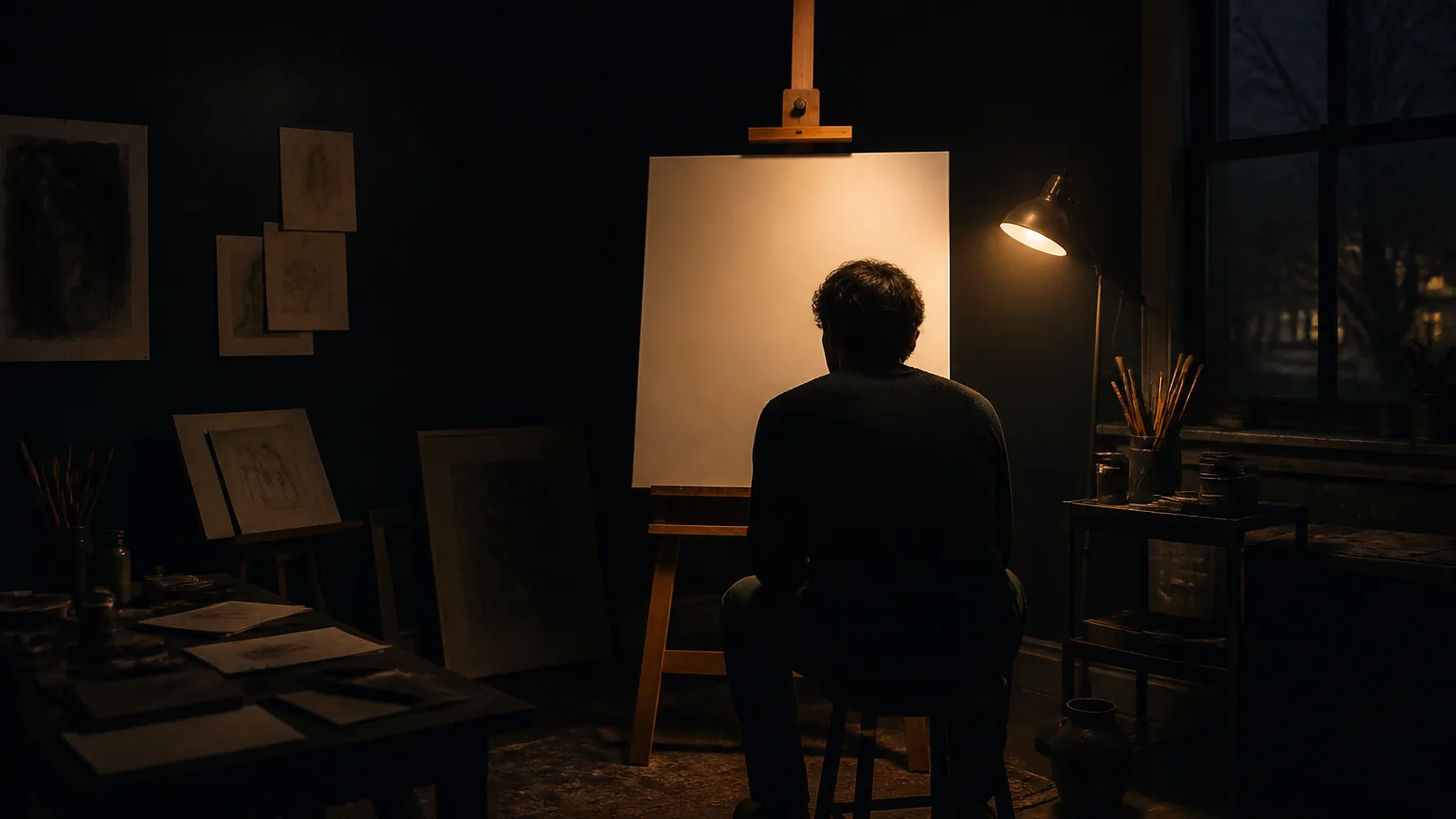
The cursor blinks. The work is close enough to feel present, yet beginning it produces a peculiar heaviness. Creative block can be logistical, but it can also be a conflict about desire and visibility. A Jungian reading treats that conflict as material, not as a verdict on talent.
“The creative mind plays with the objects it loves.”
– Carl JungWhat This Is Not
This is not a productivity system. No Pomodoro salvation. No guarantee that insight equals output.
This is not therapy or treatment for depression, burnout, or ADHD. Those may co-occur with creative struggle and deserve qualified professional care. A symbolic reading of block does not replace assessment or support.
This is not a romanticization of suffering. “The block is a message” does not mean you must stay stuck to stay deep. Messages are meant to be heard so life can move.
This is not permission to abandon craft. Desire without form becomes mood. Form without desire becomes husk. The work is their conversation.
Soulink is software for meeting desire and meaning, not a clinic, not an MFA, not a hustle cult.
Block as Refusal, Loyalty, and Spell
A creative block is often treated as a mechanical failure: wrong schedule, wrong tool, wrong caffeine. Sometimes those matter. Depth psychology adds another layer: the psyche may refuse a project that betrays a deeper desire, or that serves only the persona’s résumé.
Jung wrote of the autonomous energies of the unconscious: complexes and archetypal currents that can seize or withhold libido (psychic energy). When energy will not go into the official work, ask where it is going: scrolling, fantasy, envy, limerence, renovation shows, research that never ends. The leak is a map.
Three common spell-structures:
- Loyalty to an old identity: If you finish, you can no longer be the person who almost. Almost is safer than judged.
- Desire split from the product: You want the aura of being a creator more than the animal hours of making. The block exposes the split.
- Eros elsewhere: The real heat is in a relationship, a grief, a political rage, a body need. The project is a decoy altar.
None of these make you fraudulent. They make you human. Consciousness is what turns the spell into a choice.
Creative blocks also cluster around thresholds of visibility: the moment before a submission, a launch, a confession that the work is about you. Threshold anxiety is not only fear of failure; it is fear of being found wanting in desire itself: of being seen as someone who wants this badly. Jung’s persona prefers to want elegantly or not at all. Eros is rarely elegant on the way in. If you wait for graceful desire, you may wait out your own life’s making.
Themes of projection and the “wrong” magnetic pull, explored in attraction patterns, often appear in creative life too: you chase collaborators, audiences, or aesthetics that recreate an old emotional climate, then wonder why the work feels both electric and dead.
The Composite Vignette: The Novel That Would Not Begin
Ellis is a composite.
Ellis has three years of notes for a novel and zero chapters. Friends call Ellis disciplined in every domain except this one. Therapy-adjacent podcasts pile up. Mood boards multiply. The opening scene remains unwritten.
In a private reflection practice, Ellis names a shameful truth: the novel’s real subject is a desire Ellis has never lived: a love, a leaving, a gender of appetite that the daytime self keeps “for later.” Writing the first chapter would not only risk bad prose. It would risk making the desire real enough to demand a life.
The block was not a lack of skill. It was a guardian. When Ellis wrote a page that was allowed to be wrong and true, the guardian loosened, not forever, but enough for a beginning. The message was: stop using craft anxiety to avoid Eros.
Eros, Not Vibes: What Desire Means Here
In Jungian language, Eros is relatedness: the capacity to connect, value, and want. It is not identical with sex, though sex can carry it. A creative life without Eros becomes technique. A spiritual life without Eros becomes dry ascent. A professional life without Eros becomes elegant emptiness.
Creative block as a message from desire often sounds like:
- You are making what will be approved, not what you love.
- You are postponing the life that would feed the work.
- You are punishing the desire because someone once called it too much.
- You are asking the work to save you from loneliness it cannot fix.
Jung’s shadow teaching applies: disowned appetite returns as sabotage, envy, or sudden infatuations with other people’s art. If you want a broader map of disowned parts, see the shadow self and practical shadow work. Creative envy is frequently golden shadow: the talent or boldness you will not claim.
The Body’s Veto
Before the mind invents reasons, the body often vetoes: tight chest at the desk, sudden sleepiness, restless legs, a nausea that arrives only when the file opens. These are not always “just anxiety.” They can be Eros saying no to a false altar, or yes to a truth you scheduled out of the day.
A practice: sit with the closed laptop and ask, If this weren’t about discipline, what would I be wanting in the next two hours? Answer without nobility. Food, touch, air, a conversation, a nap, a walk without a podcast, a page that is allowed to be private forever. Sometimes fulfilling a non-work desire for thirty minutes returns more libido than two forced hours. Sometimes it reveals that the project must change shape.
Our companion essay on the body knowing first (in this draft set) extends this; for dream-side messages about stalled making, dream analysis and recurring dreams often stage unfinished rooms, broken tools, mute instruments, or stages without lines.
Perfection, Audience, and the Inner Critic’s Real Job
The inner critic rarely says the true sentence. It says this is not good enough when it means this is not safe. Safety may concern family loyalty, class mobility, religious residue, or the terror of being seen wanting.
Ask what catastrophe the critic is trying to prevent. Write it as a movie trailer. Then ask whether that catastrophe belongs to this decade or to a childhood courtroom. Shadow work prompts that target the critic live in our prompts collection; use them when you are not mid-panic.
Audience capture is Eros bent into surveillance. If every sentence is already being watched by an imaginary feed, desire has been replaced by management. A temporary discipline: one draft that no one will see, including your future branding self. Privacy can be erotic for the psyche: a room without performance.
A Method for Dialoguing With the Block
- Name the official story of the block in one cynical sentence.
- Name the underground story in one vulnerable sentence.
- Locate where the energy actually is this week (envy, crush, rage, grief, games, research).
- Write a letter from the Block as if it were a figure: what it protects, what it demands, what it fears would happen if you proceeded.
- Write a letter from Desire without using the words should or platform.
- Choose a proportional experiment for seven days: a smaller form, a private form, a truer subject, a bodily need honored before the desk.
- Review without verdict. What warmed? What stayed dead? Dead is information, not failure.
This is dialogue, not a hack. Jungian work trusts that psychic energy has intelligence even when it thwarts the ego’s plan.
When Block Is Grief Wearing a Beret
Sometimes the work will not move because a life has ended: a person, a belief, a country of the self, and the psyche will not decorate over the hole. Forcing output then becomes a violence. Mourning may be the creative act: rituals, walks, unfinished letters, silent studios that are allowed to be tombs for a season.
Spiritual and meaning crises can also freeze making; see spiritual awakening signs for the terrain of worldviews breaking. The point is discernment: is this a guardian of falsehood, or a guardian of grief? One asks for courage to want. The other asks for time to ache.
A Weekly Review for Embodied Honesty
Once a week, without improving yourself, reread your notes on sensation and desire. Look for repetition: the same room that tightens your chest; the same name that warms your hands; the same task that empties you before you begin. Repetition is how the unconscious underlines.
Write a short paragraph to your body as if it were a someone: Here is what I heard. Here is what I overrode. Here is what I will try differently: small, specific, reversible. Keep the promises tiny enough to keep. Trust rebuilds through kept micro-promises more than through dramatic vows.
If you share your life with others, you do not owe them a live broadcast of this review. Privacy protects Eros from becoming content. A single trusted conversation, chosen carefully, can be enough when isolation starts to distort the signals.
Collaboration, Envy, and the Erotic Field of Making
Making rarely happens in a vacuum. Even solitary artists swim in an erotic field of influences, rivals, beloved dead teachers, and imaginary audiences. Block intensifies when that field becomes only comparison. You are no longer in relation to the work; you are in relation to a ranking.
Jung’s notion of participation mystique, a blurring of psychic boundaries, helps explain why another person’s success can feel like a personal vanishing. The medicine is not shame about envy; it is reclaiming the envy’s content. What exact quality of theirs lights you up? Voice? Scale? Freedom from niceness? Permission to be unfinished in public? Put that quality on your experimental list for a week in your form.
Collaboration blocks deserve the same honesty. Sometimes you cannot write because the co-author relationship is carrying unspoken desire, rivalry, or caretaking. Name the field. The page often clears when the relationship becomes speakable, even if only speakable in your private mirror first.
Seasons of Libido
Psychic energy moves in seasons. There are winters where the wise act is compost: reading, resting, living material that will later become form. There are springs where beginnings are easy and finishes are not. There are summers of output that risk burnout if Eros is only mined, never fed. There are autumns of editing, choosing, letting some drafts die so others can ripen.
A block becomes cruel when you demand summer from a winter psyche. Ask what season you are actually in, not what season your peers are performing online. Jung’s respect for the unconscious included respect for its timing. Forcing can produce products; it rarely produces living work.
If you are in winter, choose winter crafts: notebooks of images, walks without destinations, conversations that refill appetite, sleep. If you are in spring, protect beginnings from premature audience. If you are in summer, schedule feeding, not only extraction. If you are in autumn, let endings be endings.
This seasonal reading also softens shame. You are not “behind.” You may be exactly on time for a cycle your persona refuses to honor because the market only applauds summer.
The Sacred and the Profane Desk
Some blocks are religious in structure even when you are not religious. The desk becomes an altar where you punish yourself for impurity of attention. Desire becomes sin; distraction becomes proof of unworthiness. A Jungian move is to desacralize the desk enough for play to return, and to resacralize life enough that the work is not asked to carry all meaning.
Try making something useless on purpose for twenty minutes: a doodle, a melody, a paragraph you will delete. Watch whether terror or relief appears. Terror suggests the persona’s salvation project is running the show. Relief suggests Eros needed a back door.
There is also the block that arrives after success. A finished project can terrify the psyche into silence because success changes the relational field: more eyes, more expectation, more chances to be loved for the wrong reason. If your last making brought attention that felt like consumption, the unconscious may withhold the next making until you rebuild a private room. That withholding is loyalty to Eros, not betrayal of ambition. Rebuild the private room first, then ask for output.
Desire that can survive a winter is stronger than desire that only knows launches.
Rekindle the Conversation With Dr. E
If your block feels less like empty and more like a held breath, you may not need another planner. You may need a private mirror for desire, envy, erotic charge, and the lies you tell to stay acceptable.
Dr. E: The Flame of Eros works that terrain on Soulink: appetite, projection, intimacy with your own wanting, including the wanting that scares you. Dr. E will not turn you into a content machine. Dr. E will help you hear what the stillness is asking.
Privacy is part of heat’s safety: EU-hosted; Soulink never trains on your words. Your desire is not training data.
Start free with Dr. E: 50 credits, no credit card, and make room for desire
Sources
- Carl Jung, The Spirit in Man, Art, and Literature (Collected Works, Vol. 15), Princeton University Press, 1966.
- Carl Jung, Two Essays on Analytical Psychology (Collected Works, Vol. 7), Princeton University Press, 1966.
- Carl Jung, The Structure and Dynamics of the Psyche (Collected Works, Vol. 8), Princeton University Press, 1960.
- Carl Jung, Psychological Types (Collected Works, Vol. 6), Princeton University Press, 1971.
- James Hillman, The Myth of Analysis, Northwestern University Press, 1997 (secondary; Eros, psyche, and imagination).