Dream Analysis · Jungian Psychology
Jungian Dream Analysis: What Your Dreams Are Really Telling You
Last night, you had a dream. Maybe you were falling. Maybe you were running through a house you have never seen but somehow recognized. Maybe someone you lost years ago sat across from you at a table and said something you cannot quite remember now, but the feeling stays with you like a bruise.
You probably shrugged it off. Most people do. We wake up, check our phones, pour coffee, and forget.
But what if the dream was trying to tell you something? What if it was not random noise — but a message?
Carl Jung spent decades analyzing dreams in his clinical work, writings, and personal journals. He built an entire branch of psychology — analytical psychology, also known as depth psychology — around the idea that dreams are the most direct, honest communication you will ever receive from the deepest part of yourself.
This is not mysticism. This is not a dream dictionary. This is a guide to understanding your dreams the way Jung understood them — as messages from your unconscious mind, speaking in a language of symbols, archetypes, and emotions that your waking mind has forgotten how to read.
Reflective note: dream analysis on Soulink is symbolic self-reflection, not diagnosis, prediction, therapy, or medical advice.
"The dream is a little hidden door in the innermost and most secret recesses of the soul, opening into that cosmic night which was psyche long before there was any ego-consciousness."
— Carl Jung
Why Did Jung Take Dreams So Seriously?
To understand why dream analysis mattered so much to Jung, you need to understand how he saw the human mind.
Jung believed the psyche has layers. On the surface is the conscious mind — the part of you that makes plans, has opinions, and thinks it is running the show. Beneath that is the personal unconscious — your private archive of forgotten memories, suppressed emotions, and experiences you have pushed out of awareness. And deeper still is the collective unconscious — a shared psychological layer that belongs to all of humanity, filled with archetypal patterns that have shaped human behavior since the beginning of recorded history.
Most of the time, the conscious mind operates like a ship on the open ocean. You see the horizon, you steer the wheel. But the ocean underneath — vast, dark, full of currents and creatures — is what actually determines where the ship goes.
Dreams, in Jung's view, are the ocean speaking.
"It is only in modern times that the dream, this fleeting and insignificant looking product of the psyche, has met with such profound contempt. Formerly it was esteemed as a harbinger of fate, a portent and comforter, a messenger of the gods. Now we see it as the emissary of the unconscious, whose task it is to reveal the secrets that are hidden from the conscious mind, and this it does with astounding completeness."
— Carl Jung, Two Essays on Analytical PsychologyJung did not see dreams as wish fulfillment, the way Freud did. He saw them as something far more useful: a self-correcting mechanism built into the psyche itself. Your dreams are not telling you what you want. They are telling you what you need — and what you are missing.
The Compensation Theory: Your Dreams Are Balancing You
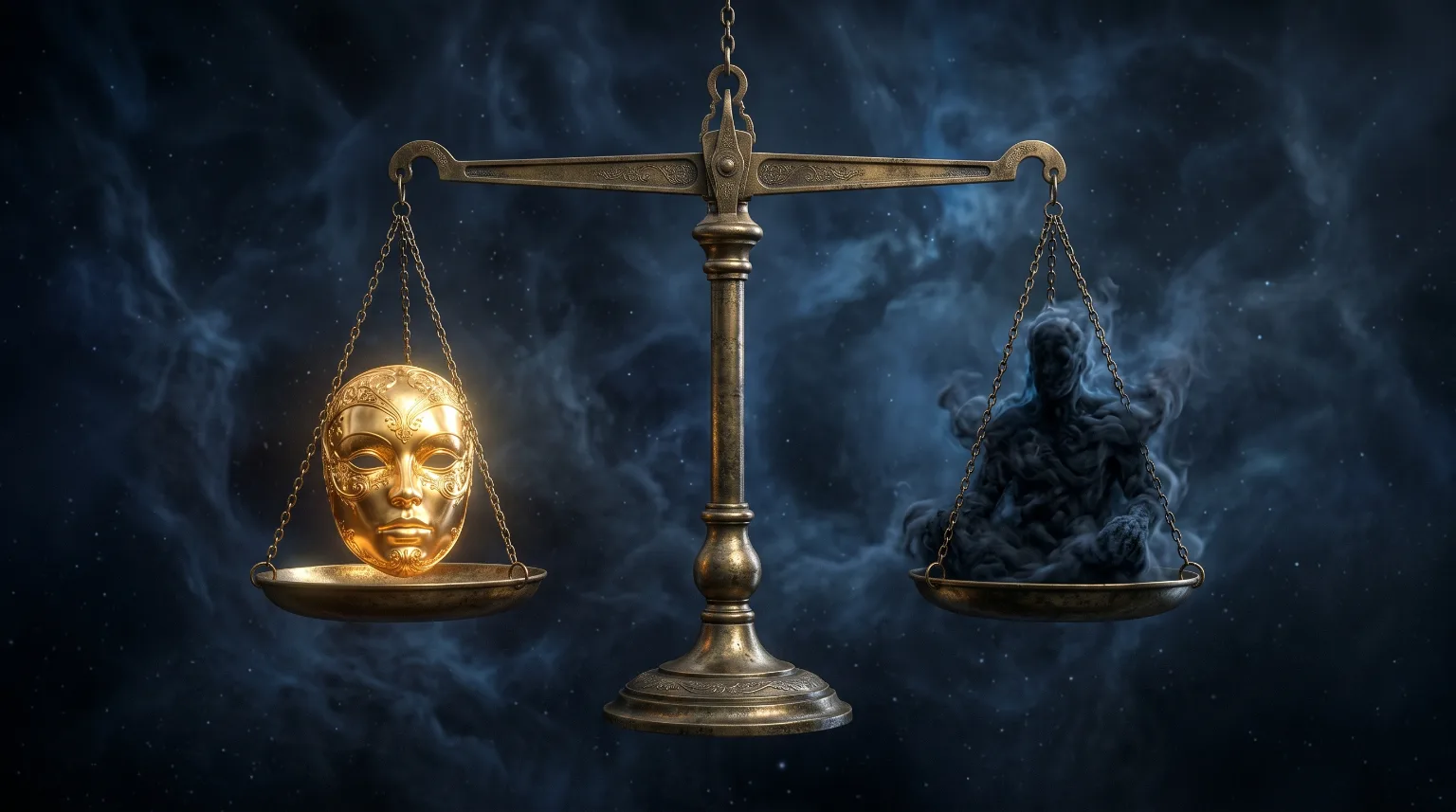
The single most important concept in Jungian dream interpretation is compensation.
Jung observed that dreams almost always compensate for something in your waking life. If your conscious attitude is too one-sided — too rigid, too optimistic, too avoidant — the unconscious sends a dream that pushes back in the opposite direction. It is the psyche's built-in equilibrium system.
Think of it this way: if you spend all day performing with confidence you do not feel, your dream that night might put you in a situation of total vulnerability. If you have been ignoring grief, your unconscious might flood your dreams with water — because the psyche will not let you forget what you are refusing to feel.
"Dreams are impartial, spontaneous products of the unconscious psyche, outside the control of the will. They are pure nature; they show us the unvarnished, natural truth, and are therefore fitted, as nothing else is, to give us back an attitude that accords with our basic human nature when our consciousness has strayed too far from its foundations and runs into an impasse."
— Carl Jung, Civilization in TransitionHere is what this means in practice. If you have a dream that disturbs you, confuses you, or seems completely at odds with how you see yourself — that is exactly the point. The dream is not broken. Your conscious perspective is incomplete, and the dream is trying to fill in the gap.
A few examples help clarify the idea. A man who avoids his responsibilities as a father might dream that his children hate him. A woman who is too attached to her social persona might dream of committing something shameful. Someone approaching midlife who has not yet found their own independence might dream of suffocating or being trapped in a small room. In each case, the dream is not punishment — it is correction.
Dreams Speak in Symbols, Not Words
Here is where most people get stuck. You have a dream about a snake, so you Google "snake dream meaning" and get fourteen different answers. That is because dreams do not work like language. They work like poetry. They work like myth.
The unconscious mind does not communicate in sentences. It communicates in images, in emotions, in symbols. And the meaning of those symbols is not universal — it is personal.
"As a plant produces its flower, so the psyche creates its symbols. Every dream is evidence of this process."
— Carl Jung, The Symbolic LifeWhen a serpent appears in your dream, it might represent transformation for one person and threat for another. The same house appearing in two different people's dreams carries two different meanings — because the unconscious is always speaking about your life, your conflicts, your blind spots.
This is why dream dictionaries are mostly useless. And it is why Jung insisted that every dream must be interpreted in the context of the dreamer's actual life situation.
He wrote:
"If we want to interpret a dream correctly, we need a thorough knowledge of the conscious situation at that moment, because the dream contains its unconscious complement, that is, the material which the conscious situation has constellated in the unconscious."
— Carl JungIn other words: to understand a dream, you need to understand yourself first — and then see what the dream is adding to that understanding.
Jung's Method: How to Actually Analyze a Dream
Jung did not have a rigid formula for dream interpretation. He saw it more as a craft than a science — something that requires patience, intuition, and a willingness to sit with ambiguity. But his approach does have clear steps, refined over decades of clinical work and outlined practically by his student Robert A. Johnson in the book Inner Work.
Here is how the process works.
Step 1: Record the Dream Immediately
Dreams fade fast. Within minutes of waking, most of the detail is gone. Jung kept a journal by his bed and wrote down every dream he could remember, including fragments. Even partial dreams carry meaning.
If you want to begin working with your dreams, this is the non-negotiable first step. Write them down. Do not judge them. Do not try to interpret while you are still half-asleep. Just capture the images, the emotions, and the sequence as accurately as you can.
Step 2: Identify the Key Images and Symbols
Every dream has what Jung called motifs — recurring images or figures that carry psychological energy. A dark figure. A body of water. A house with rooms you have never entered. A child. An animal.
List the major symbols in your dream. These are the elements that stand out — the ones that carry the most emotional weight.
Step 3: Make Personal Associations
This is where Jung's method diverges sharply from Freud's. Freud used free association — a technique where you follow a chain of thoughts until you arrive at a repressed memory. Jung rejected this. He believed free association leads you away from the dream, not deeper into it.
Instead, Jung used what he called circumambulation — circling around each image, staying close to it, and asking: what does this specific symbol mean to me? Not what does it mean in general. What does it mean in the context of my life, my emotions, my current situation?
For example: if you dream of your childhood home, don't leap to "houses mean security." Ask yourself: what happened in that house? What feeling does it carry? What part of your life right now connects to that feeling?
Step 4: Amplify the Symbols
Amplification is the technique that makes Jungian dream analysis unique. After gathering personal associations, you widen the lens. You ask: where does this symbol appear in mythology, fairy tales, religion, or culture?
If you dream of a flood, you might consider: floods appear in the Bible, in the Epic of Gilgamesh, in Hindu mythology. They almost always represent overwhelming emotion, destruction of the old order, and a forced new beginning. Does that resonate with what is happening in your life?
Jung described it this way: instead of immediately interpreting a dream, he would carry it with him, live with it, and gradually weave associations and cultural connections around it until a rich fabric of meaning emerged.
Marie-Louise von Franz, one of Jung's closest students, wrote:
"Jung did not interpret his dreams by immediately forming a clear idea of what they meant; instead, he carried them around within himself, lived with them inwardly, and asked questions of them."
— Marie-Louise von Franz, DreamsStep 5: Connect the Dream to Your Waking Life
Finally, ask: what is this dream compensating for? What is it trying to correct? What truth is it showing me that my conscious mind has been ignoring?
This is the moment when a dream interpretation "clicks" — when you feel, not just think, that you have found the meaning.
"One knows one is on the right track when there is the feeling that the interpretation absolutely hits the fact."
— Carl Jung, Seminar on Dreams
Common Dream Themes and What They Might Mean
Every dream is personal. But certain themes appear so frequently across cultures and individuals that they deserve attention. Here are some of the most common dream motifs and their possible Jungian interpretations.
Being Chased
One of the most universal dream experiences. In Jungian terms, the figure chasing you often represents your Shadow — the rejected, denied, or unconscious part of your personality. The dream is not warning you of external danger. It is telling you that something inside you is demanding attention, and you have been running from it. If this resonates, our shadow work guide walks through how to begin integrating what is being avoided.
The more you avoid it, the more terrifying the pursuer becomes.
Teeth Falling Out
Jung connected teeth to one's grip on reality, on self-image, on control. Losing teeth in a dream often signals a fear of losing power, attractiveness, or competence. It can also mark a period of major life transition — something old is falling away to make room for something new.
Water
Water in dreams almost always relates to the unconscious mind and to emotions. Calm water suggests emotional clarity. Turbulent water suggests overwhelming feelings. Floods suggest emotions you have been holding back that are now breaking through. Deep water — an ocean, a lake you cannot see the bottom of — represents the depth of the unconscious itself.
Houses and Buildings
In Jungian dream analysis, a house typically represents the psyche. Different rooms represent different aspects of your personality. The attic is the conscious mind, the intellect. The basement is the unconscious. Rooms you discover for the first time represent parts of yourself you have not yet explored.
Falling
Dreams of falling often relate to feelings of losing control, letting go, or anxiety about a situation where the ground beneath you feels unstable. Jung saw falling as the ego losing its grip — which can be terrifying, but can also be necessary for growth.
Death
Dreaming of death — your own or someone else's — rarely predicts literal death. In depth psychology, death in a dream almost always symbolizes transformation. Something is ending. An old identity, an old way of being, an old relationship pattern. The unconscious is telling you that something needs to die for something new to be born.
A Dream Inside a Dream
Nested dreams — where you dream that you wake up, but you are still dreaming — are particularly fascinating. They often indicate layers of awareness, a growing capacity for self-reflection, or a signal from the unconscious that there is more beneath the surface than you currently see. They can feel disorienting, but they are often a sign that the psyche is deepening its own process of individuation.
Recurring Dreams
If the same dream keeps coming back, listen closely. Recurring dreams are the unconscious repeating a message you have not yet understood or acted on. They will continue until you do. Jung saw recurring dreams as persistent compensation — the psyche will not stop trying to correct your course until you finally pay attention.
"Dreams prepare, announce, or warn about certain situations, often long before they actually happen. This is not necessarily a miracle or a precognition. Most crises or dangerous situations have a long incubation, only the conscious mind is not aware of it. Dreams can betray the secret."
— Carl Jung, The Symbolic Life
The Archetypes in Your Dreams
Some of the most powerful dream figures are not personal at all. They are archetypal — universal images from the collective unconscious that carry a specific kind of psychological energy. Jung identified several that appear regularly in dreams. For a full introduction to these patterns, see our guide to Jungian archetypes.
The Shadow
A figure of the same sex as the dreamer, often dark, threatening, or unfamiliar. The Shadow represents everything about yourself that you have pushed out of awareness. Meeting the Shadow in a dream is an invitation — uncomfortable but essential — to begin integrating the parts of yourself you have been rejecting.
The Anima / Animus
A figure of the opposite sex. In Jungian psychology, the Anima (in men) and Animus (in women) represent the unconscious feminine or masculine side of the personality. These figures often appear as mysterious, attractive, or emotionally charged strangers. They are asking you to develop the psychological qualities you have neglected.
The Wise Old Man / Wise Old Woman
A guide, a mentor, a mysterious elder who appears at a critical moment with knowledge you need. This archetype represents the deeper wisdom of the unconscious — the part of you that knows more than your ego does.
The Child
A child in a dream often represents new potential, innocence, or vulnerability. It can also point to unresolved childhood wounds that are still influencing your adult life.
The Great Mother
A nurturing or devouring female figure — sometimes loving, sometimes terrifying. She represents your relationship with care, dependency, protection, and the fear of being consumed.
When these figures appear in your dreams, you are not just processing daily events. You are in contact with something deeper — patterns of human experience that have been repeating since the first stories were told.
Big Dreams vs. Ordinary Dreams
Jung made an important distinction between two kinds of dreams.
Most dreams are what he called ordinary or compensatory dreams. They deal with the events and emotions of your daily life. They adjust, correct, and balance your conscious attitude. They are valuable, practical, and frequent.
But occasionally, something different happens. You have a dream so vivid, so strange, so emotionally overwhelming that it does not feel like it belongs to your everyday life. It feels like a visitation. Like something vast has spoken to you.
Jung called these big dreams. They are rare — most people experience only a handful in their lifetime. But they are among the most significant psychological experiences a person can have. Big dreams often deal with universal themes: life and death, meaning and purpose, transformation and renewal. They are filled with archetypal imagery and leave a lasting impression, sometimes for decades.
"In the end, the only events in my life worth telling are inner experiences, amongst which I include my dreams and visions. These form the prima materia of my scientific work. They were the fiery magma out of which the stone that had to be worked was crystallized."
— Carl Jung, Memories, Dreams, ReflectionsIf you have had a dream like this — one that still sits with you, that changed something inside you even though you cannot fully explain it — you have experienced what Jung was talking about. And it deserves more than a shrug.

How to Start a Dream Practice
You do not need a therapist or a psychology degree to begin working with your dreams. You need three things: a journal, consistency, and honesty.
Keep a dream journal by your bed. The moment you wake up — before you reach for your phone — write down everything you remember. Fragments count. Feelings count. Even a single image is worth recording.
Do this every morning for two weeks. You will be surprised how quickly your dream recall improves. The unconscious responds to attention. The more you listen, the more it speaks.
When you have a dream that feels significant — one that carries strong emotion or unusual imagery — sit with it. Use the method described above: identify the symbols, make personal associations, amplify with mythological or cultural parallels, and ask yourself what the dream is compensating for.
Do not rush to an answer. Jung himself said that he would carry a dream around for days, even weeks, letting its meaning slowly reveal itself. The best interpretations are felt, not forced.
And if a dream feels too intense to process alone, talk about it. Share it with someone you trust — a friend, a partner, a counselor. Naming a dream out loud has a way of making its message clearer. You can also use Soulink's AI guide Dr. J to work through dream symbols privately, at your own pace.
Why Dream Analysis Matters Now More Than Ever
We live in a culture that has lost its connection to the inner world. We spend our days consuming content, performing identities, and optimizing productivity — but rarely asking the deeper questions: Who am I becoming? What am I avoiding? What is trying to emerge from within me?
Jung warned about exactly this. He believed that modern society's disconnect from the unconscious was the root cause of widespread anxiety, depression, and what he called neurotic illness. People are out of balance — overdeveloped in their conscious persona, underdeveloped in their relationship with their own depths.
Dreams are the antidote. They are free, they come every night, and they tell you the truth — whether you want to hear it or not.
"Dreams pave the way for life, and they determine you without you understanding their language."
— Carl Jung, The Red BookLearning the language of your dreams is one of the most meaningful things you can do for your personal growth and self-awareness. It is not about predicting the future or decoding secret messages. It is about building an honest, ongoing relationship with the part of yourself that your waking mind cannot see.
Explore Your Dreams with Dr. J on Soulink
If you are ready to go deeper than a journal can take you, Soulink was built for exactly this.
Soulink is an AI-powered self-reflection platform inspired by depth psychology. Its guides help you slow down, explore symbols, and connect dream imagery to your waking patterns without reducing the dream to a generic dictionary answer.
Dr. J — The Depth Analyst is Soulink's dream interpretation specialist. Describe your dream to Dr. J, and it will walk through the symbols, the emotional patterns, and the archetypal imagery with you — the way a Jungian analyst would. It will help you make associations, amplify the dream's meaning, and connect what you dreamed to what is actually happening in your life.
Dr. J does not give you a one-line interpretation from a dream dictionary. It sits with the dream the way Jung himself recommended — patiently, carefully, with depth.
All sessions are encrypted. Your data is never sold, never used to train AI models, and stored on EU servers with full GDPR compliance. What you share with Dr. J stays between you and Dr. J.

Start free. 100 credits. No credit card needed.
Your dreams have been trying to tell you something. Maybe it is time you started listening.
Start Free Trial → Talk to Dr. JSources
- Carl Jung, Man and His Symbols, Doubleday, 1964.
- Carl Jung, The Archetypes and the Collective Unconscious (Collected Works, Vol. 9i), Princeton University Press, 1959.
- Carl Jung, Two Essays on Analytical Psychology (Collected Works, Vol. 7), Princeton University Press, 1966.
- Carl Jung, Structure and Dynamics of the Psyche (Collected Works, Vol. 8), Princeton University Press, 1960.
- Carl Jung, The Symbolic Life (Collected Works, Vol. 18), Princeton University Press, 1976.
- Carl Jung, Civilization in Transition (Collected Works, Vol. 10), Princeton University Press, 1964.
- Carl Jung, Practice of Psychotherapy (Collected Works, Vol. 16), Princeton University Press, 1966.
- Carl Jung, Memories, Dreams, Reflections, Vintage Books, 1963.
- Carl Jung, The Red Book (Liber Novus), W.W. Norton, 2009.
- Carl Jung, Alchemical Studies (Collected Works, Vol. 13), Princeton University Press, 1967.
- Carl Jung, Development of Personality (Collected Works, Vol. 17), Princeton University Press, 1954.
- Carl Jung, Seminar on Dreams, Princeton University Press, 1984.
- Marie-Louise von Franz, Dreams, Shambhala, 1998.
- James Hall, Jungian Dream Interpretation, Inner City Books, 1983.
- Robert A. Johnson, Inner Work, Harper & Row, 1986.